
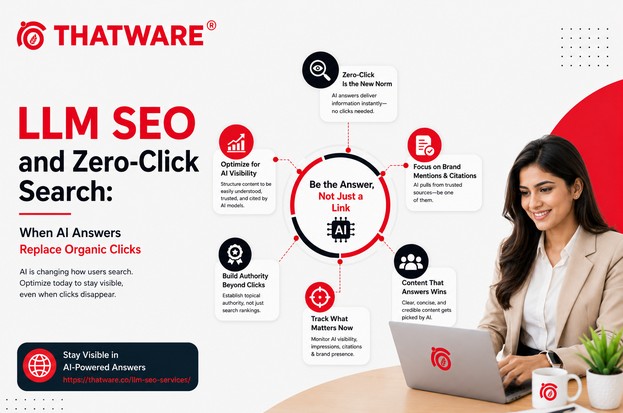
LLM SEO and Zero-Click Search: When AI Answers Replace Organic Clicks
For a long time, the zero-click search was the SEO community’s boogeyman. Google’s featured snippets started answering questions directly in the search results page — “how many cups in a gallon?” — and users got their answer without ever clicking through to a website. Traffic dropped. Publishers panicked. Debates about whether Google was a net positive or a net drain on the web’s content ecosystem got very loud.
That was the preview. The main feature is here now.
AI-generated answers — ChatGPT, Perplexity, Google AI Overviews, Bing Copilot — go much further than featured snippets. They don’t just pull a fact from a webpage; they synthesize full responses across multiple queries, often complete enough that users have no particular reason to click through to any source. Zero-click has become zero-visit in a way that would have seemed extreme even to the most pessimistic SEO analysts of 2019.
This is genuinely disruptive. And it requires a genuine rethink of what “organic visibility” means and what business value it creates.
The Traffic Implication Is Real
Let’s not pretend otherwise. If your primary online visibility strategy relied on ranking for informational queries and capturing traffic from people seeking answers, that model is under serious pressure. The queries that were most valuable for top-of-funnel awareness — “how does X work,” “what is Y,” “when should I use Z” — are exactly the ones that AI now answers directly without requiring a click.
Some categories are affected more than others. Pure information businesses (educational content, how-to guides, reference sites) are feeling this pressure acutely. Businesses where the click was just a means to an end — getting someone into a funnel — are more insulated because the thing they actually need (a purchase, a form fill, a sales conversation) still requires that the user actually engage with them.
But even in commercial categories, the discovery-phase traffic that fed awareness funnels is declining. Users are forming opinions about brands before ever visiting their websites. The AI answer is shaping the consideration set before the click happens.
What Replaces Traffic as the Value Metric
In a world where AI answers replace many organic clicks, brand mention in those AI answers becomes the new first page. Not position one in Google — presence in the AI response.
A brand that gets recommended by an AI assistant — accurately, favorably, in the right context — captures the awareness that top-of-funnel organic traffic used to provide. The user may not click through immediately. But the brand is in their consideration set. They’ll search for it directly when they’re ready to act. They’ll recognize the name when they see a paid ad. They’ll feel more familiar when a salesperson from that company calls.
This means the success metric for LLM SEO isn’t primarily traffic — it’s citation quality and frequency in relevant AI responses. And the business impact flows through brand recognition, direct search, and consideration-set presence rather than through a clean referral attribution chain.
LLM SEO vs traditional SEO is in some ways a false opposition — both matter, and traditional SEO still drives traffic for transactional queries. But the metric frameworks need to evolve. Brands that try to evaluate LLM SEO by the same metrics they use for traditional content marketing will systematically undervalue it.
The Categories Where Clicks Still Matter (For Now)
It’s worth being specific about where traditional click-through traffic still holds up reasonably well, because strategy should vary by context.
Transactional queries — actually buying something, booking something, signing up for something — still require a click. Someone asking an AI “recommend a good project management tool for a ten-person team” may get a recommendation, but the purchase happens somewhere. If the brand is recommended, the click to the website (or App Store, or sales contact form) still follows.
High-complexity research — due diligence for enterprise software, detailed technical evaluation, multi-stakeholder purchasing decisions — still drives substantial web visits even when AI is involved in the research process. The AI answer orients the research; the actual deep-dive happens through traditional web browsing.
Local services — restaurants, contractors, medical providers, service businesses — often require a website visit for practical reasons (menus, booking, credentials check). Though even here, AI is beginning to serve some of that information directly.
Understanding which of your query categories still drives valuable traffic versus which are being increasingly answered without a click helps allocate your content and LLM SEO investments more precisely.
Building Value That Doesn’t Depend on the Click
The deeper strategic response to zero-click search — whether the traditional featured snippet variety or the newer AI answer variety — is to build brand value that transcends any single traffic source.
Brand recognition that makes people search for you directly. A community that follows you through email or social, not through search. A product or service so differentiated that mentions anywhere — including in AI answers — drive intent without requiring top-of-funnel content marketing as the mechanism.
LLM SEO services strategies built for a zero-click world focus on citation and recognition rather than traffic and clicks. They optimize for how AI models describe you, not just whether they mention you. They track branded search as a downstream indicator of AI-influenced awareness. They build the kind of brand clarity that converts an AI recommendation into a direct visit — a user who heard your name in an AI answer, formed a positive impression, and came looking for you specifically.
This is, in many ways, a return to fundamentals. Brand equity. Word of mouth. Reputation. The channel for those things has changed — AI is now a major word-of-mouth mechanism — but the underlying value drivers are as old as commerce.
The Perplexity Effect: When AI Does Drive Clicks
Worth noting: not all AI search experiences are equally zero-click. Perplexity, in particular, operates as a research tool that generates citations and actively drives referral traffic to sources. Users on Perplexity click through to cited sources at higher rates than users of some other AI tools.
This means that AI citation in Perplexity specifically can still generate meaningful referral traffic — and that being cited accurately with a linked source attribution there is a distinct business value from, say, being mentioned in a ChatGPT answer that doesn’t include clickable links.
As AI search interfaces continue to evolve and differentiate, understanding the referral behavior specific to each platform becomes part of a sophisticated LLM SEO strategy. One-size-fits-all thinking won’t serve brands as well as platform-aware visibility building.
The zero-click era is here. The brands adapting fastest are the ones treating AI citation as the new front page — and building their strategies accordingly.